Friday, June 23, 2017

Emmanuel Macron's charm offensive in Brussels debut


An enormous smile on the red carpet. A flirtatious wink for the BBC's political editor. Emmanuel Macron laid on the charm from the second he stepped out of his limo at his first meeting of the European Council in Brussels.
At the president's mid-summit press conference, French journalists fought each other for the microphone to ask him a question. Everyone else just took pictures on their phones.
He wooed the EU, saying it was "a pleasure" being there, "to look at so many subjects that are dear to me."
The German newspaper Der Spiegel called him "The Summit Conqueror". "Macronmania" was the word used by others.
In the build-up to these talks, Brussels officials pointed to Mr Macron's election as proof that voters still believed in the EU.
"It's a return to the time of Nicolas Sarkozy and Angela Merkel," said one diplomat, referring to the duopoly that has often dominated the European Union.
"It's better than just having Chancellor Merkel running things on her own," he added.
The double act was sealed with a joint press conference at the end of the summit. It was standing-room only.
"When France and Germany disagree, then Europe cannot progress," he said.
It left journalists pondering what to call them: Merckron or Macrel? Although some commentators felt the Frenchman struck a more protectionist tone than Mrs Merkel, who spoke approvingly of upcoming EU trade deals.
European Parliament President Antonio Tajani observed Mr Macron's first encounter with his 27 counterparts.
"He's a highly intelligent man, at ease with the other leaders. But charm isn't an issue. They're politicians," he told the BBC.
And Mr Macron is being taught the realities of summit life.
His comments about an influx of eastern European workers being one of the causes of the UK's vote to leave the EU prompted a diplomatic row with some of his colleagues.
"Poland is open to co-operation but it depends on Macron what it will look like: whether he will want to show off his hostility to eastern Europe in the media or have a fact-based discussion," said the Polish Prime Minister Beata Szydlo.
And it looks like Mr Macron's big idea of giving the EU powers to block some foreign investment in sensitive areas of the European economy will be watered down.
"It's been downgraded," said one diplomatic source.
In Brussels Mr Macron is learning that the smile and the winks only get him so far.

Russians build three-car fidget spinner

A group of Russian motor enthusiasts have tried to make a car-based version of the fidget spinner, and very nearly succeeded in their attempts to make it spin.
In a stunt that would not look out of place on  Top Gear programme, the Novosibirsk-based Garage 54 team welded together the front ends of three Lada Samara cars to see if they could replicate the action of this year's cult toy, Russia's Sputnik news website reports.
But instead of getting the three-headed monster to spin on the spot, all they could manage was a series of ever-increasing circles as the motors worked against themselves.
"You saw it yourself. It looks like a real spinner. We didn't get the crazy spinning, as the cars started to break down," one of the team said. "But still we managed to drive three cars at once."
Previous experiments by the Garage 54 group, who have nearly 700,000 subscribers on YouTube following their escapades, include a "CatDog" where they welded two cars together. The spinner, they say, was the logical conclusion to this by adding a third.
But the car was short-lived, the Garage 54 video on YouTube - now viewed over 600,000 times - shows the "Russian spinner" being torn apart with the help of a tow-rope attached to an SUV.

Colombia conflict: Two Dutch journalists 'freed by rebels'

Two Dutch journalists who were abducted in Colombia last weekend have been released, ELN rebels have said.
They say that Derk Bolt and Eugenio Follender have been "freed in perfect condition" following their abduction near the border with Venezuela.
But the Dutch embassy in Colombia told the BBC they had no information about the claim, which could not be verified.
It was feared the kidnappings could disrupt peace talks the left-wing ELN is holding with the government.
Mr Bolt and Mr Follender were near El Tarra in the Catatumbo region, searching for the mother of a Colombian child adopted in the Netherlands.

Last year the ELN kidnapped a Spanish journalist and several Colombians in the same area. All were later released.
The ELN is the second largest left-wing guerrilla group in Colombia, behind the Farc.
The Farc signed a peace deal with the government last November, are coming to the end of a disarmament process and are preparing to enter civilian life. The ELN only started peace talks in February this year.

Online concern over Chinese 'human embroidery' trend


Chinese media are asking parents to be vigilant about a new, online trend: stitching patterns into your skin.
Online users have in recent weeks been posting pictures on social media of patterns embroidered onto their skin.
It seems to have been inspired by a forbidden Japanese cartoon, and follows a trend set by the controversial "Blue Whale" self-harm and suicide "game".
Media warn that this form of self-harm may cause a bacterial infection or a virus, and lead to septicaemia.

'Secretly spreading'


The official People's Daily warns that skin embroidery is "secretly spreading amongst young people" and shares images that users have been posting online on its Sina Weibo page.
Many of the images show participants using coloured thread to stitch patterns through the skin on their hands, legs, and even their lips. Some also add beads and ribbons as added decorations.
The pictures have received tens of thousands of comments from concerned users. Many call them "sick", "crazy", and acts of "self-mutilation".
"How could this kind of thing be fashionable?" asks "idodyu". "Yanliang520" adds: "Is playing with your phone not enough entertainment?"

Why?

While there have been many reports overseas of refugees or protesters using lip-sewing as a form of activism, there are concerns in China that this controversial trend gives appropriation to self-mutilation.
Many media say that they feel it has been popularised in China by a character in a Japanese comic, Tokyo Ghoul.
Although officially banned in the mainland, such taboo comics prove popular amongst the country's youth.
Some social media users share images of one woman, who has sewn across her lips, collarbone and arms in an attempt to look like Juuzou Suzuya, one of the show's characters.
Outlets also blame the rise in participation on the controversial "Blue Whale" internet "game", which has become increasingly popular in China over the last two months. At least one Chinese teenager has been arrested for "spreading extremism", after posting images and comments encouraging participation.
In May, the official China.cn reported that leading search engine Baidu had seen a spike in web users searching "blue whale" and related terms.
Many news portals have subsequently been cracking down on forum and chat groups believed to be encouraging self-harm.


UAE princesses guilty of servant abuse in Belgium

Eight princesses from the UAE have been convicted of human trafficking and degrading treatment of their servants by a Brussels court.
They were given 15-month suspended jail terms and ordered to pay €165,000 (£145,000; $185,000) each, with half the sum suspended.
They were accused of holding more than 20 servants they brought with them on a 2008 visit in near slavery.
But they were acquitted of the more serious charge of inhumane treatment.
The princesses had denied all the charges.
Their lawyer, Stephen Monod, said he was "satisfied to note that the Belgian justice has appropriately assessed this case which has generated many misconceptions for nearly 10 years".
He was unable to confirm that his clients would pay their fines, saying they had not yet decided whether to appeal.

'No days off'

Sheikha Hamda al-Nahyan and her seven daughters did not attend the trial and rights activists said it was highly unlikely that the UAE would extradite them had they been jailed.
The case came to light when one of the servants escaped from the hotel where the princesses had hired a floor of luxury suites.
They said they were forced to be available 24 hours a day, had to sleep on the floor, were never given a day off, were prevented from leaving the hotel and were forced to eat the princesses' leftovers.
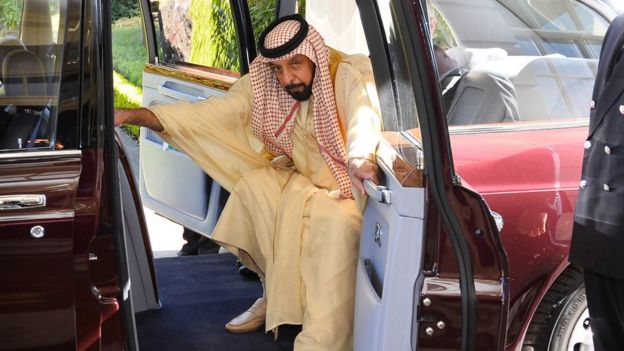
President of the United Arab Emirates, Sheikh Khalifa Bin Zayed Al Nahyan arrives at Clarence House on May 1, 2013 in London, UK

But the case took nine years to get under way, partly due to legal challenges to proceedings by the defence.
Myria, a Belgian rights group which helped bring the case to court, said the importance of Friday's judgement "can hardly be overstated".
"Not because it is the end stage of a procedure that has been epic in length and complexity, nor because the location of the transgression was a prestigious hotel and the main perpetrators princesses.
"Domestic personnel hailing from all over the world, employed in an administrative and social limbo, in a secluded area presumed beyond the reach of the rule of law, were heard in a court of law and recognised as victims of human trafficking."
At the time of the trial, Nicholas McGeehan, an expert on migrant workers in the Gulf for Human Rights Watch, told the BBC that it would be "hugely significant" if one of the wealthiest families in the world was publicly linked with trafficking and slavery.
He argued that despite being abolished in law, domestic slavery continues in Gulf states - "perpetuated by ruling elites for whom it serves an important societal purpose in conferring status".
He added: "It's top-down and tolerated.".

Ebola virus burial teams may have 'saved thousands of lives'

They were ordinary people doing an extraordinary job in extremely dangerous times.
Now new research suggests Red Cross volunteers who helped bury most of the bodies of Ebola victims in West Africa could have prevented more than 10,000 cases of the deadly disease.
More than 28,000 people were infected with Ebola in 2014-2015. Of those, 11,310 people died.
The worst affected countries were Guinea, Liberia and Sierra Leone.
A major part of the response was ensuring the safe burials of people who had died of Ebola. The bodies of victims were particularly toxic.

Community funerals, where people helped wash the bodies of their loved ones, contributed to so many people becoming infected in the earlier stages of the outbreak.
Within months, the epidemic had become the worst public health emergency of modern times.
The study, published in the PLOS Neglected Tropical Diseases journal, used statistical modelling to measure the impact of the Red Cross safe and dignified burial programme.
Researchers focussed on 45 unsafe community burials and the 310 people who were identified as having had contact with the infected bodies. They found, on average, just over two people went on to develop Ebola for every unsafe community burial that took place.
The bigger risk was to those who cared for a loved one with Ebola before their death. Researchers found many more infections could have been prevented if the sick were treated in hospital rather than by their families and communities.
However, using these estimates, the study suggested safe and dignified burials by Red Cross volunteers prevented between 1,411 and 10,452 cases of Ebola.
The authors said these are conservative estimates.
They highlighted a number of limitations in the study, including the challenges of collecting very personal and sensitive information about funerals, and the length of time between when some of the burials took place and when the data was collected.

Ending the war

Hundreds of paid volunteers took on the grim task of collecting bodies from people's homes in full personal protective gear, while also having to manage the grieving families and communities.
They were ordinary West Africans, such as teachers and college students. Many carried out the relentless and dangerous work for months.
Some were stigmatised in their communities, because people became scared they might bring the virus home with them.
In reality, they were helping to stem world's worst ever Ebola outbreak.
"It was very difficult work," said Red Cross volunteer Mohamed Kamara who I spent a day with as he collected bodies in Sierra Leone in January 2015.
"It's good news that people realise the impact of what we did to help end the transmission of Ebola," he said while reacting to the findings of the study from the capital Freetown.
"Some people didn't even want to come near us at that time.
"But the team we worked with helped give us the courage to do this important work… and we ended this war."


Whale body size warning for species collapses

The shrinking size of whales over the 20th Century could help scientists detect when wildlife populations are in trouble, a study suggests.
The analysis shows that the average body size of four whale species declined rapidly during the second half of the 20th Century in response to hunting.
But warning signals were visible up to 40 years before whale stocks collapsed.
The work appears in Nature Ecology and Evolution journal.
Christopher Clements, from the University of Zurich in Switzerland, and his colleagues looked at records on the abundance and body size of whales caught by commercial whaling vessels between 1900 and 1985, after which a global whaling moratorium took effect.
"We looked at data on blue, fin, sei and sperm whales and found significant declines in body size, with sperm whales taken in the 1980s four metres shorter on average than those in 1905," said Dr Clements.
This probably occurred as the biggest individuals were selectively removed from the ocean through hunting.
"This means that warning signals were detectable up to 40 years before a population collapse," Dr Clements added.
A similar pattern has previously been reported for many fish populations, and has been interpreted as a response to fishing pressure.
The results suggest that tracking changes in the mean body size might help to predict when populations are at risk of collapsing.
"Our technique could be used to help provide other species of conservation concern. Moreover, it could allow interventions to be put in place to stop this happening," said Christopher Clements.