Sunday, May 14, 2017

Smartphones that charge in five minutes 'could arrive next year'

Smartphones with batteries that fully charge in five minutes could be available to consumers next year.
The technology was first shown off in 2015, when Israeli start-up StoreDot demonstrated its FlashBattery at the CES tech show in Las Vegas.
Chief executive Doron Myersdorf told the BBC it is now expected to enter production in early 2018.
However, Ben Wood, a technology analyst at CCS Insight, said he had doubts about the claims.
Mr Myersdorf said he could not reveal which manufacturers were signed up to use the technology.
In 2015, he told the BBC his firm's battery contained materials that allowed for "non-traditional" reactions and the unusually fast transfer of ions from an anode to a cathode - the electrical process that charges a battery.
The design involves nanomaterials, which feature extremely small structures, and - unnamed - organic compounds.
Some versions of the battery were thicker than most smartphone batteries at the time, but now Mr Myersdorf has claimed it is ready for the market.
"We will charge a smartphone in five minutes," he said.
He added that the technology was in pilot production at two Asian battery makers and that "mass production" was expected to commence in the first quarter of 2018.
Mr Wood, while remaining unconvinced whether the rollout would happen as quickly as claimed, did admit that if the battery worked as planned, then it could be a major moment in the industry.
"Taking risks with battery technology can bite you," he told the BBC. "I would say that experience has taught me to always remain sceptical. Let's see if it happens would be my view."
He pointed out, for example, that any design that generates large amounts of heat can impact the performance of the battery.
However, he added that anyone who did manage to crack the "battery problem" could have a transformational effect on consumer electronics.
Other manufacturers are also working on quick-charging battery tech.
In November, Qualcomm announced its Quick Charge 4 system, for example, that offers five hours of battery life following a five-minute charge.
StoreDot also unveiled an electric car battery that charges in five minutes at a tech show in Berlin this week.
The firm said the battery provides 300 miles of range.
A demonstration of the technology was given at the Cube Tech Fair - though the short presentation ended before the battery had finished charging.
"We don't have contracts but we are working with car companies to develop the battery - this will take another three years or so to be on the road," said Mr Myersdorf.
By contrast, Elon Musk's electric vehicle firm Tesla says its Supercharger technology takes 75 minutes to fully charge the battery in one of the firm's cars, such as a Model S for example.
A 30-minute charge would allow for 170 miles of range with the same system.
"Consumers want charge times similar to filling up their cars at a petrol station," said Joe Kempton, an analyst at Canalys.
But real applications would depend on "whether the technology can be produced at a large enough scale" and at the right cost, he added.

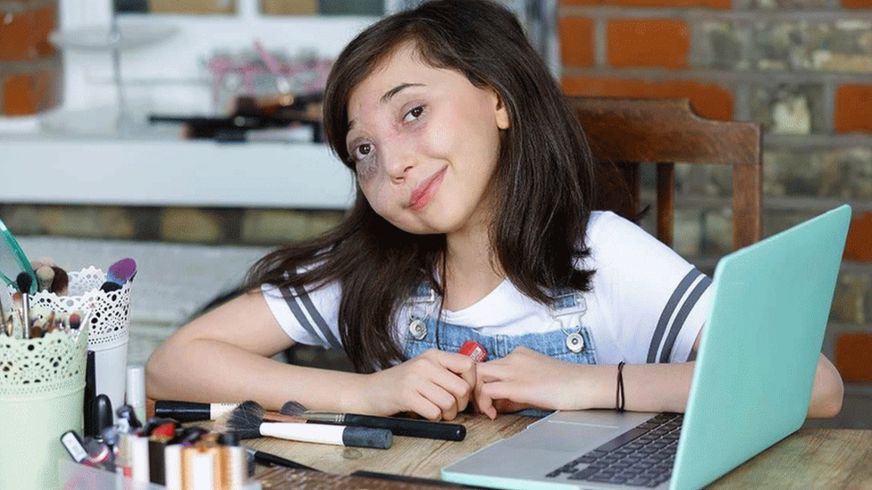
The rise of the tweenage vlogger

Nikki Christou, 12, known in the vlogging world as Nikki Lilly, makes YouTube videos about baking, make-up and a rare medical condition known as arterial venous malformation (AVM), something she was diagnosed with when she was six.
Her condition has resulted in a severe facial disfigurement and the constant risk of life-threatening nosebleeds.
She doesn't get many "haters" on her channel but admits that when she began vlogging, the cruel comments did upset her.
"It definitely got to me at first, and I may have shed a few tears - but, as I've grown as a vlogger, I've learnt that the comments from the haters are basically all the same.
"They may say things like, 'You are ugly,' but really they don't like themselves and they have nothing better to do."
Nikki currently has more than 200,000 subscribers to her channel and hopes to break the million mark at some point.
Making videos started as a hobby, a natural follow-on from the role-playing games she already loved.
When she began posting them to YouTube in 2013, she became part of a new generation of tweenagers - children from eight to 13 - who run their own channels.
She advises any newbies to "make sure they always show what they have made to their parents".
At first, Nikki's parents, worried by the reaction she might receive, insisted that the comments section was turned off.
But her mother says that once they saw how much it meant to Nikki and how much she craved feedback, they changed their minds.
Shauna Pomerantz, associate professor at the department of child and youth studies at Brock University in Ontario, Canada, says Nikki is a great role model for young girls.
"She is the champion of the not-perfect girl, and she is absolutely inspirational to watch," she told the BBC.
"I can see why people love her - she is a hero to anyone who feels like an outsider."
Across the pond, 13-year-old American dancer and singer JoJo Siwa vlogs about much the same thing as Nikki Lilly, although, with more than three million followers, she is better established.
There are, says Prof Pomerantz, thousands of similar girls on YouTube and they are "mostly white, upper-class, pretty and thin".
Prof Pomerantz's own nine-year-old daughter is a mega-fan of JoJo's, and while her daughter doesn't know why she likes her so much, her mother thinks there are two main reasons.
"Firstly, this is a world where no adults are visible and it is fantastic for children to see a world where kids are in charge."
The second reason is likely to be the normalcy of the videos.
"This stuff is really very mundane," Prof Pomerantz says.
"Any adult watching would be bored within seconds.
"These vloggers invite their fans on closet tours, show them how to do a high ponytail, show them their underwear."
And this means children can relate to these "stars" in ways a previous generation could not, says Prof Pomerantz.
Gone are the days when celebrities were one step removed, in the pages of a glossy magazine or on the set of a TV programme - now children are quite literally invited to look around their bedrooms.
Nikki Lilly is a huge fan of Zoella, who, at the grand old age of 27, is a veteran of the beauty vlog.
She says she loves her because "she is like a chatty girl next door".
But Zoella, like other celebrity vloggers, has another secret to her success, a willingness to share her vulnerability with her fans - in her case, crippling anxiety
Much has been written about how the YouTube generation are growing up with no privacy - willing to share on social media every detail of their lives, but Prof Pomerantz is not overly concerned.
"While their mothers may have kept a diary under lock and key, now there is a different way of sharing secrets and young people are happy to tell the world," she says.
"In some ways, this is a form of empowerment.
"Young people are more likely to be open and honest."
Journalist Zoe Williams worries, though, that YouTube could be spawning a generation of egotists.
Writing about Zoella in the Guardian newspaper, she says: "Her delight in the inconsequential is perversely infectious; there is something rather relaxing about the company of a person who will say out loud anything that pops into their head."
But, she adds: "The depth of her fascination with herself is also rather alienating."

Camera-ready

There is no shortage of children desperate to mimic their YouTube heroes and start their own vlogs - but, for the vast majority, stardom is unlikely to follow.
Amanda Lenhart, a senior research scientist at the NORC Center for Public Affairs Research, says for those who do not get many followers, it is simply a valuable life lesson.
"It is not pleasant, but is it any different from wanting to be a professional football player and finding you are not good enough? It is part of growing up," she says.
Justin Escalona, 20, who started a YouTube channel with his friends when he was 11, has some advice for children wanting to do the same.
"I think having an outlet for young kids to express their creativity is a positive thing," he says.
"Just don't put stupid or inappropriate stuff online and don't worry about getting views."
Now a film student, his vlogs have morphed into slick, cinematic affairs, but he advises children against feeling the need to always be "camera-ready".
"Just be genuine," he says.
"If you're faking the best version of yourself, it will show over time.
"If you're sharing your genuine high points, along with maybe your not-so-high points, people will respect and like you for being real."

Eurovision 2017: Portugal's ballad wins contest

Portugal have won the Eurovision Song Contest for the first time in the competition's history.
Salvador Sobral, 27, won with his love ballad Amar Pelos Dois, which was written by his sister.
He said on receiving the trophy: "We live in a world of fast food music. This is a victory for music... music isn't fireworks, music is feeling."
Lucie Jones, representing the UK with I'll Never Give Up on You, came 15th. Bulgaria came second and Moldova third.
Jones, a former X Factor contestant, received 111 points for her performance but didn't seem too upset, tweeting: "I wonnnnnnn!!! Oh no wait..."
It is a considerable improvement for the UK, after last year's entrants Joe and Jake came 24th with 62 points.
Jones secured the UK's highest placing since 2011, when boyband Blue came 11th with 100 points.
Sobral, who has a serious heart condition that saw him miss the first week of rehearsals, reprised his song at the end of the show and was joined by his sister Luisa for a duet.
Their song, which translates as For the Both of Us, won top marks from both from the televoters and the countries' professional juries, getting 758 points altogether. This dwarfed Jamala's win last year for Ukraine with 534 points.
Portugal had been one of the favourites to win, along with Italy's entry, which came sixth.
It wasn't all about the singing, though - last year's winner Jamala had her performance briefly interrupted by a man flashing his bottom.
BBC Monitoring reported that Ukrainian TV identified him as "scandalous" Ukrainian prankster Vitaliy Sedyuk. Jamala continued to sing "unfazed", the broadcaster 1+1 TV said.
The stage invader, wrapped in an Australian flag, was swiftly wrestled off the stage by a security guard.
Graham Norton, who was guiding UK viewers through the contest on BBC One, apologised to anyone who was offended by the incident.
The contest this year took place in the Kiev International Exhibition Centre in Ukraine. The host country could only manage 24th place out of 26 this time round.
Portugal will now host the contest next year.
The noise in the press room at Kiev's International Exhibition Centre was deafening as Salvador Sobral from Portugal became his country's first ever Eurovision winner.
To say the 27-year-old is a popular victor is an understatement. Where others brought slick precision sheen and dancing gorillas to the contest, he brought heart, sincerity and a simple, guileless charm.
He also brought something of a sob story - a recent bout of ill health and a serious heart condition. Yet it would be an injustice to him and his songwriting sister Luisa to suggest that sentiment was behind his triumph.
He is, simply put, one of a kind - an antidote of sorts to Eurovision's history of short-lived fads and trashy kitsch, and all the more refreshing for it.
A journalist I know choked up when discussing how he felt when he saw Salvador sing Amar Pelos Dois (Loving for the Both of Us).
Sabral entered the contest with the stated aim of making "people outside of Portugal know and recognise my work."

Tinkering for science on the Irrawaddy

"Poohsticks" is what you might call entry-level hydrology.
Drop twigs over a bridge on the upstream side and then race over to the downstream side to see which bits of wood appear first.
Good fun, for sure, but the scientist in you may also learn something about stream behaviour.
This is essentially what Delft University of Technology's Thom Bogaard and Rolf Hut have been doing in Myanmar. Together with local students, they've been playing a kind of poohsticks on the Irrawaddy River... with coconuts.
Their aim has been to understand how this mighty watercourse moves, how it mixes, how it might disperse and dilute pollution if faced with such a problem.
In the West, scientists would resort to all sorts of fancy, high-end equipment that costs hundreds, even thousands, of dollars. "But this is Myanmar; they can't afford that," said Dr Bogaard. "They have no information on water quality at the moment. They know a bit about sediment, but that's it. So, we decided to use citizen science to see how far we could go to get basic data."
Start with 300 coconuts. Attach them to coloured balloons that also contain a small bicycle light for visibility at night; and then just throw them in the river.
The density of a coconut is almost one, which means it sits submerged at the surface of the water and is driven by the current alone, not the wind. It's the perfect, low-cost ("off the tree", even edible) scientific drifter.
Those dropped in the middle of the Irrawaddy will in all likelihood move the fastest; those near the bank will very probably move the slowest. "And what you do is position your student teams on bridges and watch them pass by,” explained Dr Hut.
"They just mark the times: 'It's now 09:45 in the morning and there's a blue one, and there's a white one'. What you see is a curve develop at one bridge, and then this bell shape gets broader at the next bridge. And that allows you to say something about the average changes in velocity between the bridges."

It's not enough of course, so Bogaard, Hut and their band of students and technicians - from Yangon Technological University and Myanmar Maritime University - upped the level of sophistication.
This took the form of a block of wood topped with styrofoam. To this platform they attached a waterproof plastic box containing a GPS tracker, data card, and cell transmitter - the sorts of components that the Western "maker movement" (DIY technogeeks) like to play with all the time.
The whole contraption - still costing less than $150 - is weighted to sit in the river properly with chunks of metal cut from an old car.
This drifter can report its own position and velocity as it heads downstream. The group used 15 of these devices at the confluence of the Irrawaddy and its major tributary, the Chindwin.

The latter carries more sediment and contaminants, but it takes many kilometres before these become fully mixed in the Irrawaddy.
The data gathered earlier this year will now be used to model the river's behaviour, to better forecast how a pollution incident might propagate in time.
"The ultimate aim is to make sure the local people can do this kind of thing themselves," said Thom Bogaard.
"To be honest, it takes quite a bit of experience to know how to build these makeshift devices, but I think we've got them started. We had about 10 students and local technicians and it was a fabulous success. We were able to discuss how we do the science and you could see them flourish and get the mindset that is needed to monitor a river like the Irrawaddy."
But Rolf Hut doesn't want this approach to be seen as some kind of patronising hand-me-down. He's adamant that "tinkering for data" should be in the arsenal of every scientist, wherever they work.
"For a lot of applications in the Western world it's just beneficial to have lower cost, tinkered sensors because it opens the opportunity to get far more geo-scientific data than would otherwise be possible.
"Too often people think they need to buy a standard device and if it breaks they have to send it away and wait for it to come back. No! Fix it; make something of your own. Use a coconut!"
Thom Bogaard and Rolf Hut presented their work in Myanmar to the recent European Geosciences Union (EGU) General Assembly. A video recording the project is on YouTube.

Lack of dust makes China's air pollution much worse

Airborne dust is normally seen as an environmental problem, but the lack of it is making air pollution over China considerably worse.
A new study suggests less dust means more solar radiation hits the land surface, which reduces wind speed.
That lack of wind in turn leads to an accumulation of air pollution over heavily populated parts of China.
The researchers found that reduced dust levels cause a 13% increase in human-made pollution in the region.

Sands from the Gobi

Hundreds of millions of people across China continue to be impacted by air pollution from factories and coal-fired power plants.
Studies suggest that the dirty air contributes to 1.6 million deaths a year, about 17% of all mortalities.
But this new research says that the human-induced pollution is being made worse or better by naturally occurring dust that blows in from the Gobi desert.
Using models to simulate 150 years of wind and dust patterns in the region, the researchers found that the dust deflects significant amounts of sunlight.
Without it, more heat from the Sun hits the land. Differences in the temperatures between land and sea cause the winds to blow. Without the dust, the land warms up more and that changes the temperature differential with the sea leading to weaker breezes - and more air pollution.
"There are two dust sources. One is the Gobi and the other is the highlands of north-west China, but we found the Gobi had much more influence," said lead author Yang Yang, from the Pacific Northwest National Laboratory in Washington State, US.
"Less dust in the atmosphere causes more solar radiation to reach the surface. It weakens the temperature difference between the land and the sea and impacts the circulation of the winds and causes a stagnation over eastern China and that causes an accumulation of air pollution."

Small change, big impact

The decreases in dust emissions are considerable, varying by almost a third. The impact on winds speeds are quite small by comparison, a reduction of barely more than one-tenth of one mile per hour.
However, when this takes place on a large scale over a wide region, the small change in speed means a 13% increase in the amount of air pollution over eastern China during the winter.
Another study has recently shown a link between declining Arctic sea ice and a major air pollution event in China in 2013.
The authors of the new study believe that both theories could be true.
"Our study has the same mechanism: the weakening of winds causes more pollution, and what is behind this needs to be studied," said Yang Yang.
"We have two views on this kind of weakening of wind. They found the sea ice, we found the dust-wind interaction can also lead to weakening of the wind. I think both of them are important."
The researchers believe that the study may inform broader questions about how natural and human-created aerosols interact.
Many parts of the world, in addition to China, are now suffering from increased levels of air pollution and understanding how dust, winds and emissions work together may help limit some of the worst impacts of dirty air.
One of the key lessons from this study is that the absence of dusty conditions could mean the air you are breathing is worse for you, not better.
"You're damned if you do, damned if you don't," said Prof Lynn Russell from the Scripps Institution of Oceanography in California.
"Dust emissions can impair visibility, but they are not so harmful in terms of air quality," she told BBC News.
"If it's not a dusty year, you may be happy and spending more time outdoors because you don't have this dust in the way, but you are actually going out to spend more time in more toxic air."
The study has been published in the journal Nature Communications.

Sunday, May 7, 2017

Albatrosses counted from space

Scientists have started counting individual birds from space.
They are using the highest-resolution satellite images available to gauge the numbers of Northern Royal albatrosses.
This endangered animal nests almost exclusively on some rocky sea-stacks close to New Zealand’s Chatham Islands.
The audit, led by experts at the British Antarctic Survey, represents the first time any species on Earth has had its entire global population assessed from orbit.
The scientists report the satellite technique in Ibis, a journal of the British Ornithologists' Union.
It is likely to have a major impact on efforts to conserve the Northern Royals (Diomedea sanfordi).
Ordinarily, these birds are very difficult to appraise because their nesting sites are so inaccessible.
Not only are the sea-stacks far from NZ (680km), but their vertical cliffs mean that any visiting scientist might also have to be adept at rock climbing.
"Getting the people, ships or planes to these islands to count the birds is expensive, but it can be very dangerous as well," explained Dr Peter Fretwell from BAS.
This makes the DigitalGlobe WorldView-3 satellite something of a breakthrough.
It can acquire pictures of Earth that capture features as small as 30cm across.
The US government has only recently permitted such keen resolution to be distributed outside the military and intelligence sectors.
WorldView-3 can see the nesting birds as they sit on eggs to incubate them or as they guard newly hatched chicks.
With a body length of over a metre, the adult albatrosses only show up as two or three pixels, but their white plumage makes them stand out against the surrounding vegetation. The BAS team literally counts the dots.
The researchers first checked their methodology at Bird Island, South Georgia.
This is a unique nature reserve in the South Atlantic where the nests of another species of great albatross, the Wandering albatross (Diomedea exulans), are individually marked with GPS locators.
The biggest confounding factor is large, light-coloured rocks. But the analysis showed the team could get a very close match between the pixelated birds in the space images and the nests that were recorded in the ground-truth data.
There tends to be a slight over-counting, which the team puts down to breeding partners or non-breeding birds also being captured in a satellite scene.
Applying the technique at the Chatham Islands, the team counted just over 3,600 nests. This is slightly down on a manual count of 5,700 that was made in 2009.
Dr Fretwell said: "The breeding numbers we counted were much lower than we anticipated, which could show us that the population is declining or it could show just that we had a particularly poor year. But this illustrates why you have to do this over several years, and doing it by satellite is going be a lot cheaper and more efficient."
Dr Paul Scofield at Canterbury Museum, NZ, is a co-author on the Ibis paper.
He described the difficulty of counting the birds in the traditional way at the group of stacks known as the Forty Fours.
"The 44s are particularly tricky," he told BBC News. "I once waited a whole month on the main Chatham Island for the weather to clear so I could land.
"Even if you use a plane, it's a problem as planes are only available infrequently and the wind and cloud prevent flying. Then if you take photos, you have to count them. That can take 100s of hours. This technology still requires the satellite to be in the right place and no cloud but it is certainly cheaper and more reliable."
Like the other five species of great albatross, Northern Royals are under pressure for a variety of reasons.
Commercial fishing has depleted the stocks on which these seabirds also feed, and the baited longline gear used by some vessels has an unpleasant knack for attracting foragers and pulling them underwater where they drown.
But the Northern Royals in particular are vulnerable because of their desire to nest only on the Chatham Islands sea-stacks. If one big storm rolls through at the wrong time of year, it can severely dent breeding success.
"In 1986, a huge storm washed waves over these 50m-tall islands," said Dr Scofield.


Germany searches all army barracks for Nazi material

Inspections have been ordered at every German army barracks, after Nazi-era memorabilia was found at two of them.
The defence ministry said the command came from the inspector general of the Bundeswehr (Germany's armed forces).
All barracks will be searched for material linked to the Wehrmacht, the army which served Adolf Hitler.
The move follows a growing scandal over far-right extremism within the army, with an officer accused of plotting an attack disguised as a Syrian refugee.
The army lieutenant, who had expressed far-right views, was arrested in late April.
Prosecutors in Frankfurt said the 28-year-old suspect had a "xenophobic background".
Germany's Defence Minister Ursula von der Leyen cancelled a planned trip to the US and travelled to his garrison in Illkirch, northeastern France.
Officials found Wehrmacht memorabilia openly displayed there in the common room, despite a ban on Nazi symbols.
A second barracks, Fürstenberg in Donaueschingen, southwest Germany, was then sucked into the scandal on Saturday after a display cabinet was found containing Nazi-era helmets.
Spiegel online reported that pictures of Wehrmacht soldiers were found on a wall, along with Nazi pistols, more helmets and military decorations.
A Defence Ministry spokesman told Reuters the items found in Donaueschingen did not include Nazi objects punishable under German law, such as swastikas.
However, Ms Von der Leyen said last Wednesday that she would not tolerate the veneration of the Wehrmacht in today's army.
She said the latest scandals were no longer isolated cases, adding that "a misunderstood esprit de corps" had led senior officers to "look the other way".
The minister later apologised for the tone of her criticism, after political opponents accused her of smearing the whole army.